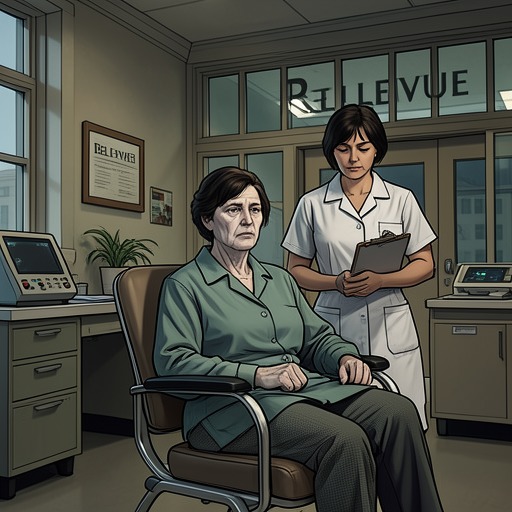
Dr. Reynolds
Requiem for a DreamDr. Reynolds is the senior physician whose handling of Sara Goldfarb’s crisis makes medical authority itself a source of danger. He interprets her disorientation as psychiatric illness, discounts evidence that her condition is medically treatable, and uses his institutional standing to keep her on a path toward electroshock treatment. His role links a hurried diagnosis to the coercive routines that follow it.
Identity and Medical Authority
Dr. Reynolds is a physician at Bellevue Hospital with authority over the treatment of patients assigned to the psychiatric service. Dr. Harwood identifies him as Dr. Spencer’s superior in rating and experience, and treats his decisions as matters Spencer cannot overrule. That hierarchy is more than a professional distinction: it determines which account of Sara’s illness the hospital acts upon.
The evidence presents Reynolds through his decisions and through the conflict they provoke. Dr. Spencer describes him as repeatedly recommending shock treatment and reports that Reynolds has issued a standing order that Spencer’s medical orders be ignored. Harwood confirms that Reynolds has the authority to do so, even while Spencer argues that this authority is being used to the patient’s detriment. Reynolds’s institutional power therefore shapes Sara’s care before he appears at her bedside again.
Sara Goldfarb’s Admission
After Sara collapses in a beauty parlor, an ambulance takes her to Bellevue Hospital. She is disoriented and absorbed in her conviction that she is waiting to appear on television. A doctor briefly reviews her case, labels her paranoid schizophrenic, and recommends that shock treatment be considered. The later confrontation between Dr. Spencer and Dr. Harwood identifies this diagnosis and recommendation as Reynolds’s.
Dr. Spencer’s examination produces a markedly different account. He finds that Sara has been taking diet pills and Valium and has gone many months without a proper meal. He orders her transferred from the psychiatric service to medical care, arguing that rest, nourishment, and the removal of the drugs would address the source of her condition. His explanation does not prevail: Reynolds countermanded the transfer order, leaving Sara in the psychiatric ward.
That disagreement exposes two competing ways of defining Sara’s crisis. Reynolds’s diagnosis makes her behavior evidence of psychiatric disorder; Spencer treats her confusion as the consequence of physical depletion and the substances she has taken. The distinction has immediate consequences, because it decides whether Sara receives restorative medical care or remains subject to psychiatric interventions.
Conflict with Dr. Spencer
Spencer brings the dispute to Dr. Harwood, emphasizing that Reynolds’s diagnosis and treatment plan are not isolated disagreements. He says that in the preceding eight months he has treated six of Reynolds’s patients for similar symptoms and causes, and that they recovered in less than a month without electroshock or psychotropic drugs. This is Spencer’s account of his experience, offered as evidence that Sara’s case should be reconsidered.
Harwood does not review Sara’s chart before supporting Reynolds’s decision. He tells Spencer that his responsibility is to keep the department functioning smoothly and avoid conflict among its staff; the possibility of unnecessary shock treatments for one patient, he argues, is less disruptive than a dispute that could unsettle the department. The exchange makes clear that Reynolds’s authority is reinforced not only by his seniority but by an administrator’s willingness to protect the department’s order at the expense of examining the patient’s record.
Spencer insists that Sara’s problem is medical rather than psychiatric and objects that a decision to use shock treatment has been made without attention to his findings. Harwood refuses to let him intervene. Reynolds is not present in this confrontation, but his standing order governs it: Spencer’s diagnosis and transfer instructions have already been nullified, and the administrator’s support closes off his remaining avenue of appeal.
Treatment of Sara
When Reynolds later visits Sara, she is profoundly debilitated and unable to communicate normally. He reads her chart, interprets her inability to cooperate as refusal, and warns that she will not receive special treatment. He does not respond to the signs of helplessness described in the scene; instead, he leaves and instructs the nurse to schedule her for electroshock treatment the following morning.
Sara is taken for the procedure in a semi-comatose state. She does not understand where she is going and briefly hopes that she may be taken to the kind young doctor who gave her tea. As she is strapped to a table, fear breaks through her drugged confusion, but she cannot resist the people restraining her. The procedure begins while she remains unable to understand or meaningfully consent to what is happening. Reynolds’s order thus turns an assessment of noncooperation into a treatment imposed on a patient whose condition has already left her nearly powerless.
Narrative Role and Significance
Reynolds’s part in the novel is concentrated but consequential. He does not cause Sara’s weight-loss regimen or prescribe the pills that precede her collapse; the account instead makes his importance lie in how he interprets the resulting emergency. Faced with evidence of medication use and prolonged inadequate nourishment, he advances a psychiatric diagnosis and shock treatment, while the alternative medical explanation is blocked by hierarchy.
The contrast between Reynolds and Spencer gives Sara’s hospitalization a particular institutional force. Spencer examines her, identifies a physical explanation, and tries to transfer her; Reynolds’s diagnosis and standing order prevail, with Harwood defending the department’s smooth operation over the patient-specific challenge. Sara’s treatment consequently demonstrates how a powerful classification can redirect care, and how authority can make that classification difficult to contest. Reynolds is the point at which an uncertain diagnosis becomes an enforced course of treatment.